
Marcel Heisler

Christian Becker-Asano

Publication
Two publications at RO-MAN 2026
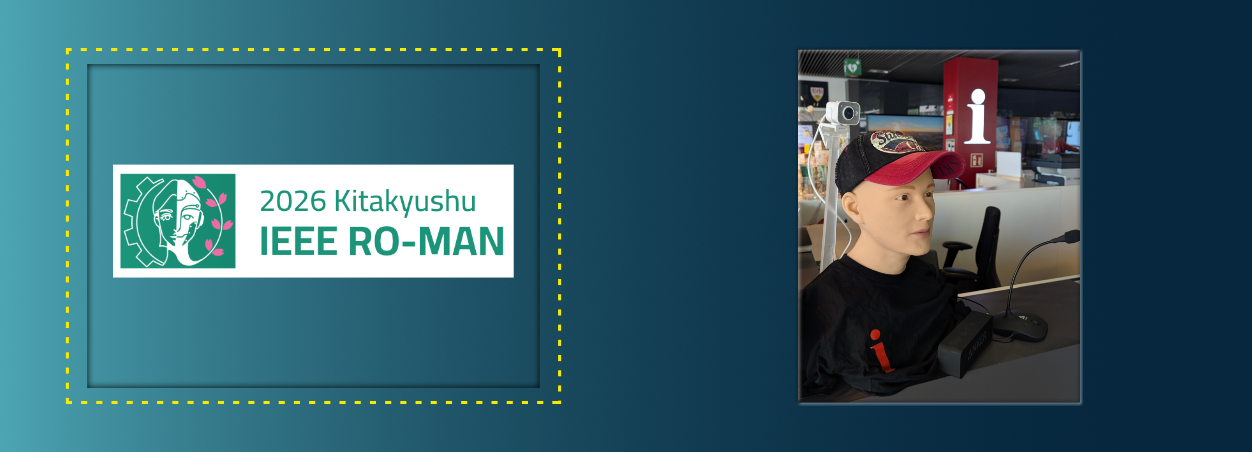
We are happy to share that two papers from our Humanoid Lab have been presented at the 35th IEEE International Conference on Robot and Human Interactive Communication (RO-MAN) in Kitakyushu, Japan.
A Case Study on the Acceptance of a Humanoid Robotic Head Employed in Three Public Spaces
In this joint work with HdM’s Startup Center we explored the acceptance of our robot heads with human-like appearance in real-world scenarios across the city, setting it up at the city library, the tourist information center and building authority.
Abstract
Previous research has shown that a human-like robot’s acceptance heavily depends on the setting in which it operates and its ability to perform relevant tasks. This paper, first, reports on how our robot processes natural language to generate a multimodal, verbal response integrating emotional expressions based on an emotion simulation backend. Then, it describes how visitors were invited to speak with our robot in their own language at three different, public locations, where the robot was running continuously for several days. The TAM2 questionnaire results reveal that on average users were motivated to use the robot and found it rather useful and easy to use regardless of the specific location. However, public spaces like the tourist information and the city library seem to be a better fit for our interactive, robotic head than an office environment such as the building authority, where the willingness to interact was lower. Overall, the robot’s multi-lingual responses were very much appreciated, but every fifth user found the response time too slow impeding the dialog flow, which remains to be improved in future work.
Authors: Marcel Heisler, Luca Randecker, Christian Becker-Asano
Preprint: Link to Arxiv
Not Forgotten: Implementation and Evaluation of a Personalized Episodic Memory for the Humanoid Robot Head Kim
This paper resulted from Steve Aschenrenner’s Master’s thesis in which he implemented a memory system for our robot heads and evaluated its effect on users’ perception of the robot.
Abstract
Social robots that rely on large language models for conversation are unable to retain information across sessions. This absence of memory violates social expectations, potentially preventing the formation of persistent relationships. This paper presents a lightweight episodic memory module that integrates vector-based semantic retrieval with an LLM-controlled dialog system, deployed on the humanoid robot head Kim. The module employs a hybrid scoring function combining cosine similarity with a memory strength metric to retrieve contextually relevant past interactions and inject them into the generation prompt. The system was evaluated in a within-subjects video-based online study (N = 43) using the Human-Robot Interaction Evaluation Scale (HRIES). Results show that episodic memory significantly increased perceived sociability (d = 0.60, p < .001), with the strongest effects on perceived trustworthiness (d = 0.62) and warmth (d = 0.56). Perceived disturbance remained unchanged (d = 0.00), indicating that the implemented approach to personalized recall did not trigger privacy-related discomfort or uncanny valley effects. These findings suggest that episodic memory serves as a social lubricant in embodied Human-Robot Interaction, enhancing relational quality without eliciting negative affective responses.
Authors: Steve Aschenbrenner, Marcel Heisler, Thomas Sievers, Christian Becker-Asano
Preprint: Link to Arxiv